In the UK, almost anyone can incorporate a company and the range of activities is huge, from accounting (69201) right through to space transport (51220). No matter what your business does, you must have a SIC code to operate legally in the UK. In this article, we will break down what a SIC code is, why it matters, how to choose the right one, and everything else in between.
What Is A SIC Code?
In simple terms, a SIC (Standard Industrial Classification) code is a 4-5 digit code used to describe a businesses main activities. Organisations such as Companies House and the ONS (Office for National Statistics) use SIC codes for administrative and statistical purposes.
SIC codes were first introduced in the UK in 1948, following their introduction in the US in 1937; they have been a legal requirement for businesses ever since.
Why Does Your Business Need One?
As mentioned, having a SIC code is a legal requirement if you incorporate a company. There are a few key reasons why this is necessary, which are outlined below:
Government & Statistics
Organisations such as the Office for National Statistics (ONS) use SIC codes to keep track of economic activity across different industries. This information helps the government understand how various sectors are performing and guides decisions around economic planning and policy making.
Compliance
SIC codes need to be chosen when you incorporate your business to comply with Companies House rules. If you later want to update the description of your business activities, you will need to provide the new SIC code in the next Confirmation Statement, as discussed later in this article.
Industry Analysis
By grouping companies under SIC codes, it makes it easier to track and analyse growth, employment, and overall performance within specific industries.
Business Clarity
SIC codes help provide clarity about a business by clearly showing what it does and the industry it operates in. This makes it easier for regulators, investors, and other organisations to quickly understand and accurately classify the company.
When Do I Need To Choose One?
The short answer is; you need to choose a SIC code when you incorporate. You will not be able to proceed with incorporating without it. It will be submitted alongside your first confirmation statement after incorporation.
You can choose one by looking at the Companies House SIC Codes list and determining which one best suits your business activities. An example of the range of SIC codes can be seen below:
- 68100 - Buying and selling of own real estate
- 03120 - Freshwater fishing
- 10520 - Manufacture of ice cream
- 43110 - Demolition
- 60100 - Radio broadcasting
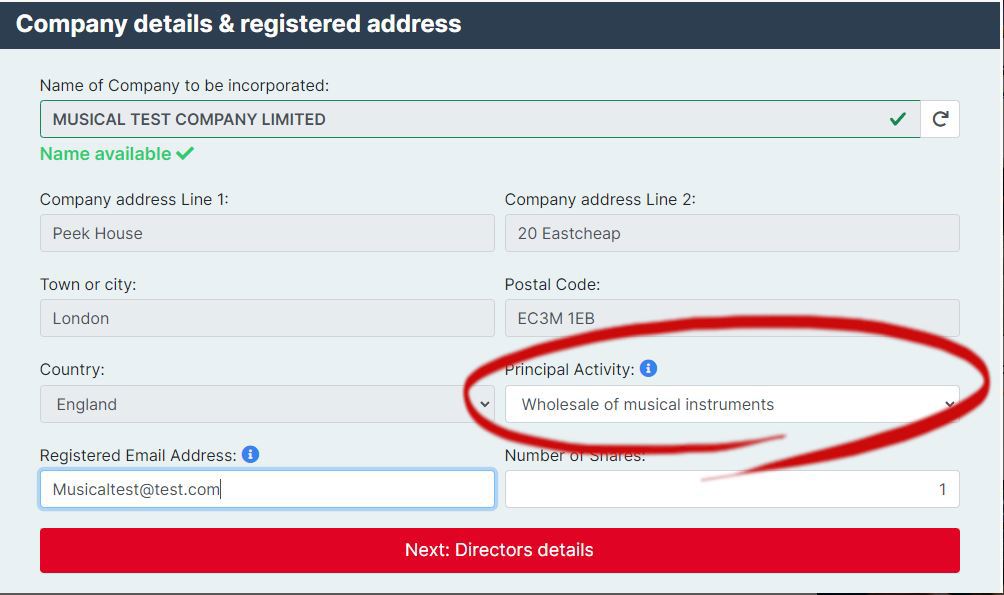
For example, let’s say a business wants to incorporate a company at Companies House so it can sell flutes in bulk to other businesses. To find the right SIC code, they would look through the list and select the 'Wholesale and retail trade' category in Section G. Within that section, they need to find the SIC code 'Wholesale of musical instruments'; 46491.
When you incorporate a company with Easy Digital Company you will need to add the SIC code when you complete the company details before incorporation:
That is just one example of the many SIC codes outlined by Companies House. There are actually over 600 different SIC codes available, so there is no need to worry - there will be one that’s suitable for your business!
My Business Is Not Trading, Does It Need One?
Yes - even if the business is non-trading or dormant, it will still need to provide a SIC code. This is a standard requirement, so every company must have one listed, regardless of its current trading status.
- 74990 - Non-trading company
- 99999 - Dormant company
Where Is The SIC Code Displayed?
The SIC code will be publicly available on the Companies House website. When you look up your company details, you will find it listed under the 'Nature of business (SIC)' section, where Companies House shows information about what the business does.
Can I Have More Than One SIC Code?
Yes - in the UK, a business can have more than one SIC code.
Companies House allows you to register up to four SIC codes for one company, which is really helpful if your business does more than one thing. The main thing is to make sure the codes you pick accurately describe what your business does overall, even if one activity takes priority over the others.
How Do I Change My SIC Code
If you are looking to update your SIC code, you can do this when filing your next confirmation statement with Companies House. Companies House do not require you to update the SIC code before the confirmation statement is due, however, if you wish to do so then you can always file your confirmation statement early to make these changes.
Does My LLP Need One?
No - SIC codes are only required for Limited Companies. If you run a Limited Liability Partnership (LLP), you do not need to provide a SIC code, as LLPs are exempt from this requirement under Companies House rules.
Looking For Further Information?
I hope this article has helped to explain everything you need to know about SIC codes and their requirements. To learn more about topics relevant to small and micro businesses, please explore our Knowledge Base. If you have additional questions, please do not hesitate to contact us.